For years, carbon markets in Kenya have been presented as a promising way to attract climate finance. Now, the country is trying to answer a more difficult question: how can it profit from carbon trading without compromising the climate commitments it has made at home?
That question sits at the centre of Kenya’s new carbon-market strategy.
On October 5, the government launched the Kenya Guide for Strategic Engagement in Carbon Markets 2026, a framework intended to guide Kenya’s participation in international carbon markets and make decisions around carbon-market projects more transparent and predictable.
The timing matters. Kenya is seeking private investment for renewable energy, forestry, agriculture, waste management and clean cooking, while also trying to protect its Nationally Determined Contribution (NDC) under the Paris Agreement.
The government says the two objectives can coexist, but only if carbon markets are built around integrity and communities.
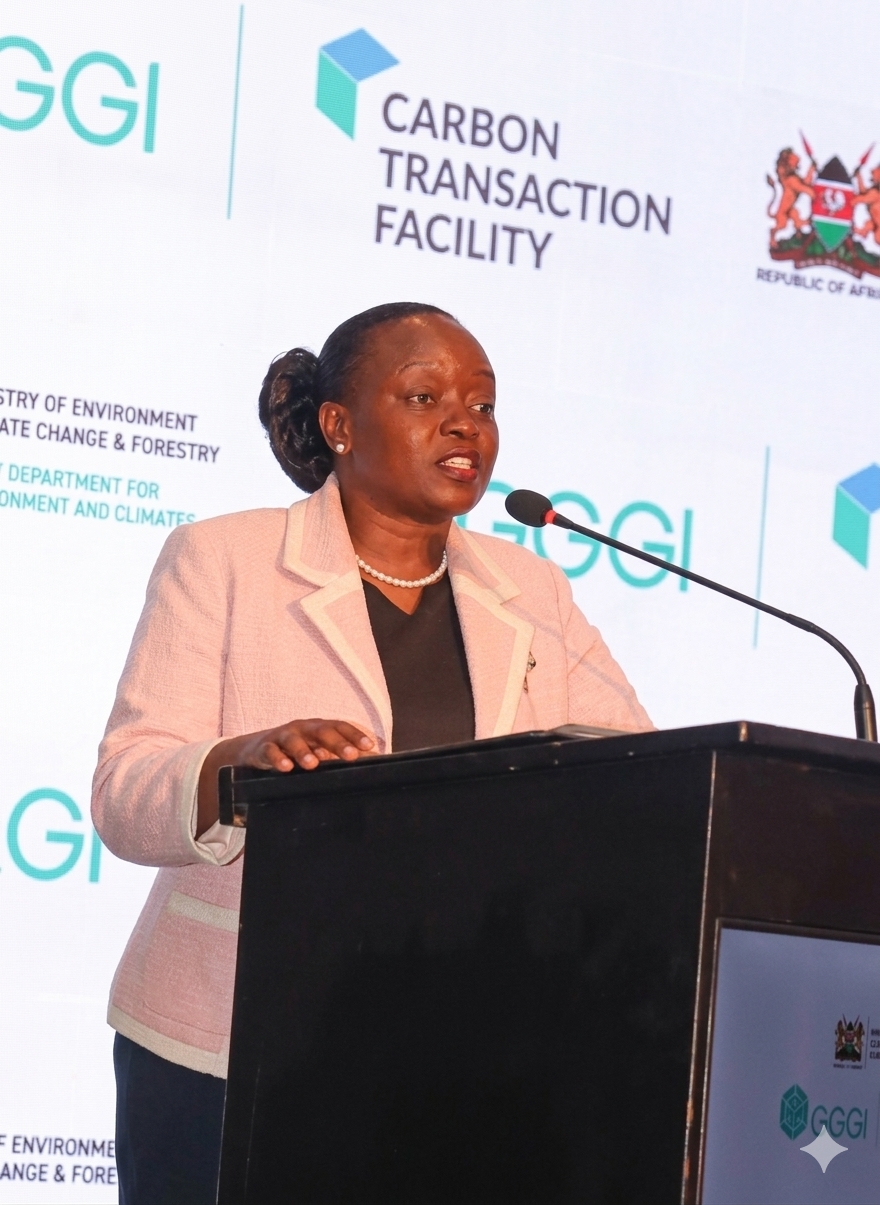
Cabinet Secretary for Environment, Climate Change and Forestry Deborah Barasa said Kenya is open to responsible carbon investment, but insisted that such investment should create lasting development value rather than come at the expense of communities or the environment.
The new guide establishes a 10-million-tonne cumulative ceiling for international transfers of carbon dioxide equivalent between 2025 and 2030, according to reporting on the framework. The limit is intended to reduce the risk of Kenya transferring too many mitigation outcomes abroad and weakening its own climate targets.
That makes the ceiling more than a technical figure. It places a boundary around how much of Kenya’s climate mitigation can become an international commodity.
Carbon markets depend heavily on trust. Buyers need to know that a claimed emissions reduction is real, measurable and not being counted twice. Governments also need to know where mitigation outcomes originate and what happens to them after they are transferred.
Kenya has been building the infrastructure to address those concerns.
The Kenya National Carbon Registry, launched in February 2026, is designed to track and manage carbon-market projects, credits and internationally transferred mitigation outcomes. The registry is intended to strengthen transparency and help prevent problems such as double counting and double issuance.
The European Union is also putting money behind that infrastructure. Kenya is set to receive KSh590 million, approximately €4 million, in EU support to strengthen monitoring, reporting and verification systems for carbon-market activities and national climate action.
For Kenya, stronger monitoring is not simply a technical exercise. Credible systems can make the country's carbon projects more attractive to international buyers while giving the government greater oversight of what is being traded in its name.
But the most consequential question may be closer to the ground: what happens to the communities where these projects operate?
Carbon projects can involve forests, agricultural land, renewable-energy facilities and other resources connected to local livelihoods. The people living around them therefore have a stake that extends beyond the eventual sale of a carbon credit.
Kenya's new framework says communities should benefit through equitable benefit-sharing, employment, skills development, technology transfer and local value creation. It also places emphasis on environmental and social safeguards and stakeholder engagement.
That commitment will be tested in implementation.
Kenya now has a carbon-market regulatory framework, a national registry and a strategic guide for international engagement. But rules on paper do not automatically guarantee fair outcomes.
The challenge will be ensuring that projects are properly monitored, communities are meaningfully involved, benefits actually reach them and international transactions do not undermine Kenya's own climate ambition.
The country's carbon-market experiment is therefore about more than selling emissions reductions.
It is about deciding what Kenya is willing to sell, what it needs to keep for its own climate future, and who gets to benefit from the value created along the way.