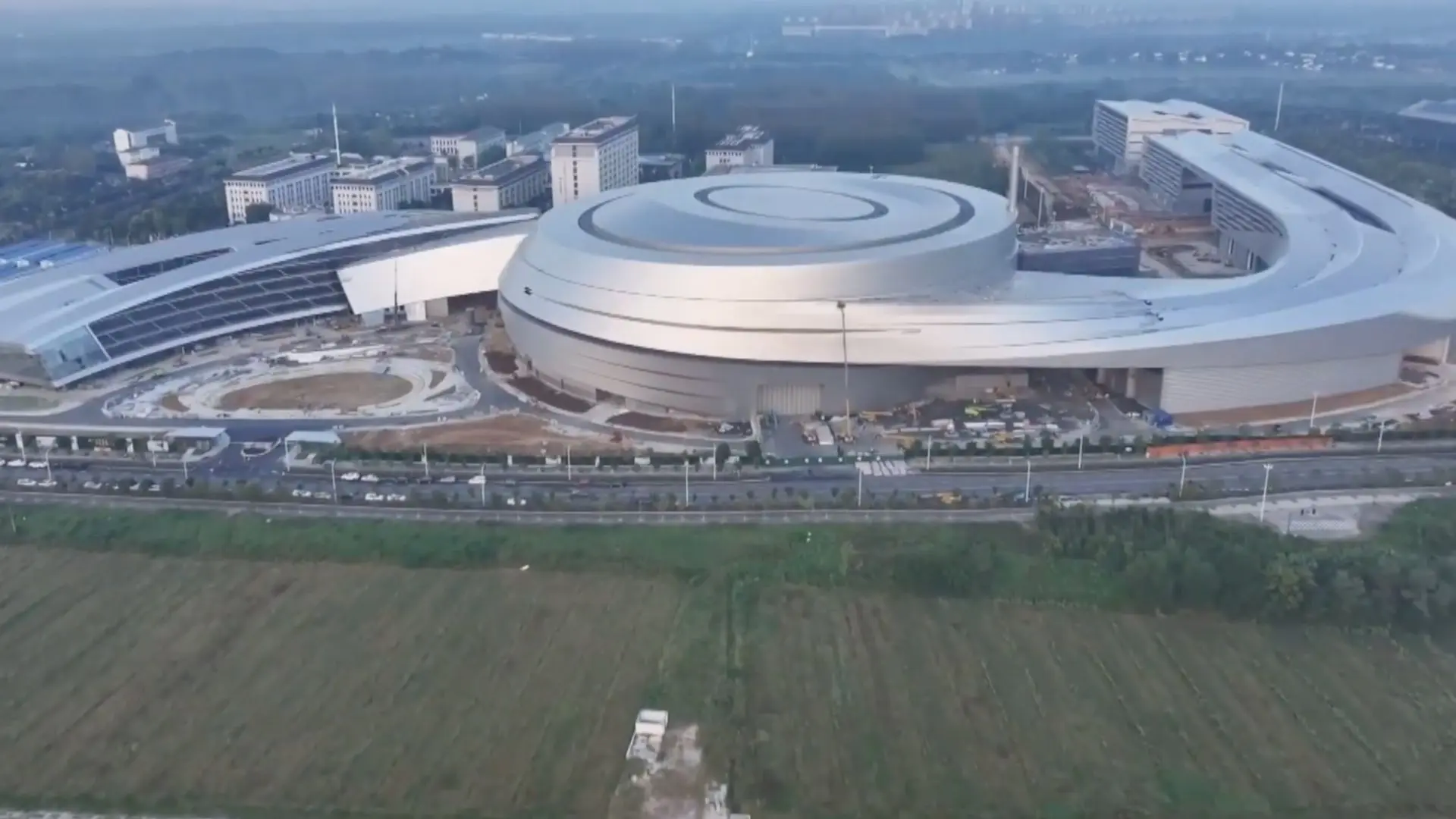
China has completed the main complex of its Burning Plasma Experimental Superconducting Tokamak, known as BEST, in Hefei, Anhui Province, marking a major milestone in the country's ambitious effort to develop controlled nuclear fusion as a future source of energy. The completion came on October 1, ahead of China's National Day holiday, as engineers prepare to move deeper into the assembly of the experimental fusion facility.
BEST is one of China's major nuclear fusion projects and is often described as an “artificial sun” because it is designed to recreate conditions similar to those inside the Sun. Unlike conventional nuclear power plants, which generate energy through nuclear fission, fusion attempts to release energy by forcing light atomic nuclei together under extremely high temperatures and pressures.
The project uses a tokamak design, a doughnut-shaped device that uses powerful magnetic fields to confine extremely hot plasma. Inside the future BEST machine, components including the vacuum vessel and superconducting magnets will work together to maintain and control the fusion plasma. The magnets must operate at extremely low temperatures while the plasma itself can reach temperatures of more than 100 million degrees Celsius.
The completion of the outer complex does not mean BEST is already producing fusion energy. Engineers are still assembling the main machine, with key components being installed layer by layer. These include the vacuum vessel, cold shield and toroidal field magnets, all of which are essential to creating and controlling the environment required for a sustained fusion reaction. More than half of the overall assembly work had been completed by the latest construction update.
BEST is being developed as a major step between China's existing fusion research, including the Experimental Advanced Superconducting Tokamak, or EAST, and future demonstration reactors intended to move fusion technology closer to commercial electricity production. China's fusion programme has increasingly focused on moving beyond experimental plasma research toward systems capable of demonstrating actual energy generation.
The project is designed to conduct deuterium-tritium burning-plasma experiments, using the same basic fusion fuel combination being investigated by major international fusion programmes. Chinese authorities have said BEST is intended to demonstrate net fusion power gain and eventually contribute to the country's efforts to demonstrate fusion-generated electricity. Earlier plans have targeted around 2030 for a demonstration of fusion power generation.
The facility is currently scheduled for completion by the end of 2027. If the project remains on schedule, scientists will then be able to begin a new phase of experiments focused on burning plasma and the engineering challenges involved in extracting useful energy from fusion reactions.
China's progress comes as governments and private companies around the world compete to develop practical fusion energy. Fusion is attractive because it could potentially provide large amounts of low-carbon energy using fuel derived from hydrogen isotopes. However, scientists still face major challenges, including sustaining fusion conditions, managing intense neutron radiation, developing suitable reactor materials and converting the resulting energy into commercially viable electricity.
For China, BEST represents another major investment in a long-term strategy to develop fusion technology and build the engineering expertise needed for future demonstration reactors. The completion of its main complex is therefore an important construction milestone, but the more difficult scientific test will come when the facility begins operating and attempts to sustain burning plasma under controlled conditions.